

Inside Strokkur: How We Developed Our Feelplex Contact Microphone for Extreme Recordings
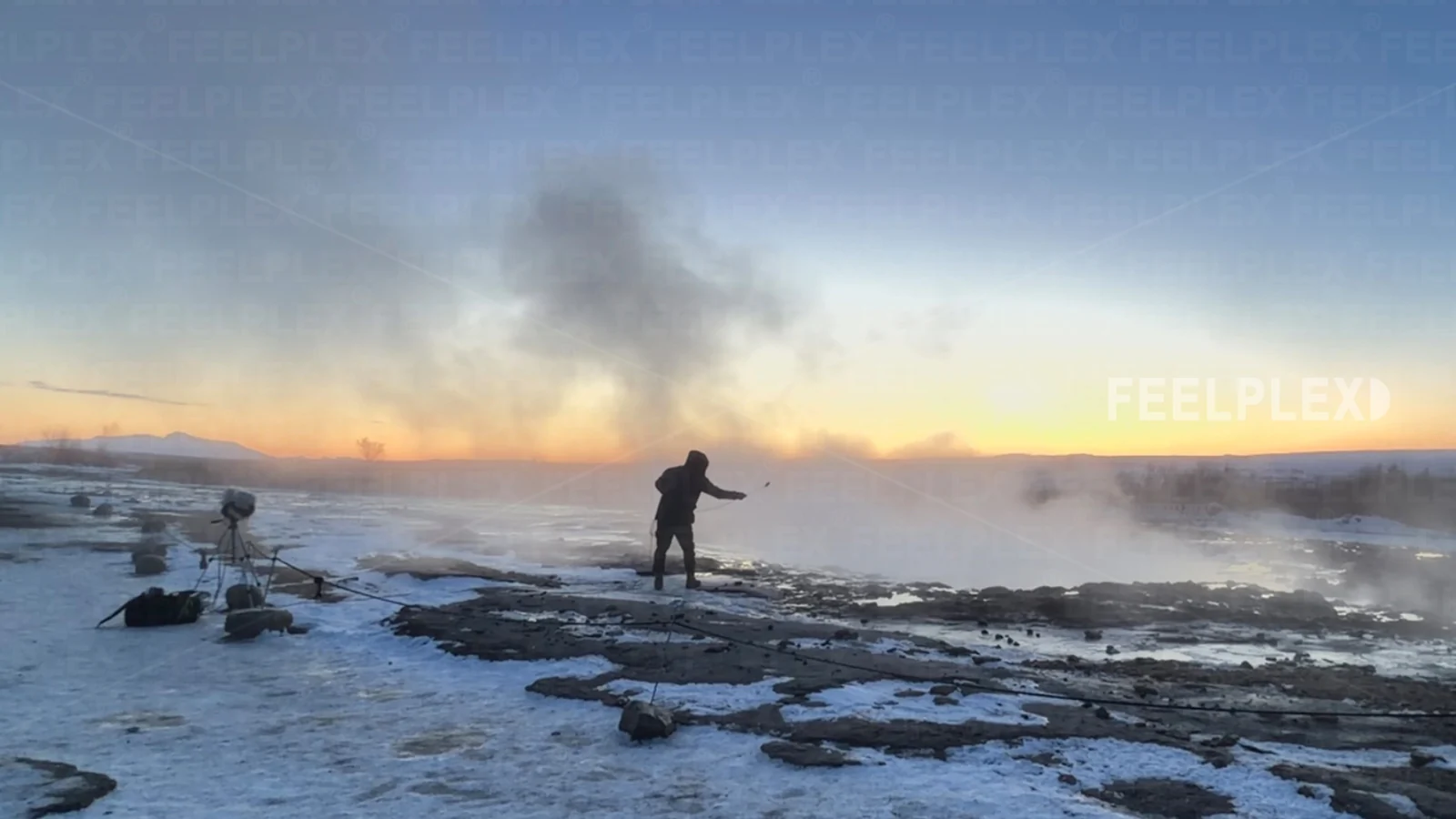
A geyser does not announce its eruption with a countdown. At first, the surface seems calm. Then the water begins to pulse, steam rises, and suddenly a towering fountain shoots into the sky. We wanted to do more than watch that moment. We wanted to capture its full acoustic force, both above and below the water. That curiosity led to our Strokkur project, with four recording channels and a contact microphone of our own design.
Why Strokkur?
Strokkur is located in Iceland’s Haukadalur geothermal area, along the Golden Circle route. Its frequent eruptions make it a fascinating place to record sound. Each eruption has its own sequence: a brief moment of anticipation, a sudden burst, a rising column of water, and the rush as the water falls back. We wanted to make that entire sequence audible.
The setting is impressive, but demanding. Hot water, steam, wind, and shifting forces require particular care. For our recordings, sound quality mattered, but so did the resilience of the equipment. A geyser cannot be directed. You have to be ready when it erupts.

Recording starts long before you press “REC”
A single microphone can hardly capture the entire soundscape of a geyser. Above the surface, we hear the explosive eruption, the roar of the fountain, and the sounds of the surrounding landscape. Underwater, different vibrations emerge: low thuds, bubbling, and moving water. That is why we chose to record two stereo perspectives simultaneously.

The landscape above the water
Two external microphones capture the eruption, the rising steam, and the surrounding sounds, creating a spatial impression of the geyser.
The heart of the geyser
Two specially developed, protected contact sensors capture mechanical vibrations underwater, offering a second perspective on the same eruption.
This led to our four-channel concept with two stereo perspectives:
- Channels 1–2 · Air stereo: Two air microphones capture the eruption and its surroundings from a safe, permitted location.
- Channels 3–4 · Underwater stereo: Two custom-developed contact microphones record vibrations underwater.

Both stereo pairs were used for the recording. This allowed us to examine the sounds above the surface and the vibrations beneath it separately during editing, then combine them into one soundscape.
Why we developed our own contact microphone
An air microphone captures sound pressure in the atmosphere. For the second stereo perspective, we are developing an enclosed piezo-based contact microphone designed to respond to mechanical vibrations underwater. Such a contact sensor is not automatically a calibrated hydrophone. Its sensitivity and suitability for direct underwater recording require separate testing.
The challenge is that piezo sensors are highly sensitive to how they are mounted. Loose contact, impacts on the housing, moisture at connections, and interference-prone cables can affect a recording as much as the event itself. Developing a sensor for extreme underwater conditions therefore means considering mechanical coupling, long-term sealing, thermal resistance, and electronics as one system.
How we designed the Feelplex contact microphone
1. Piezo elements: turning vibration into a signal
Inside are piezoelectric elements that convert mechanical deformation into electrical voltage. Their mounting is crucial: they must be able to pick up vibrations without leaving delicate components exposed to stress.
2. Brass as the contact surface
The piezo elements are mounted on a brass plate. Brass is durable, easy to machine, and provides a reproducible mechanical interface. Whether it delivers the desired frequency response can only be determined by comparing different contact surfaces and test recordings.

3. A gear-shaped design with a practical purpose
The distinctive gear-shaped outline is more than a design choice. Its edges are intended to support controlled handling and secure attachment to the designated mount. Whether the housing can withstand the thermal and mechanical stresses of underwater use must be verified separately. Installation in Strokkur’s basin would require official authorization and a professional safety plan.
4. Rubber encapsulation against moisture and impacts
The sensor housing is encapsulated in rubber to protect sensitive components from moisture and mechanical stress. However, ordinary rubber encapsulation alone does not establish safety or watertightness for use in hot geothermal water. The surface can also provide grip and damping. At the same time, damping involves an acoustic trade-off: the housing should reduce unwanted interference without excessively suppressing the vibrations we want to capture. Actual watertightness and acoustic transmission must be demonstrated through testing.

5. Low-noise signal routing via XLR
Field cables rarely enjoy studio conditions. For the two underwater channels, temperature resistance, strain relief, and pressure-tight cable feedthroughs are also essential. We plan a shielded, balanced audio connection with an XLR interface on the dry connection side. With piezo sensors, proper impedance matching is vital: an XLR connector alone does not turn a high-impedance piezo signal into a low-noise, balanced output. That is why we are developing and testing the signal path and recorder input together.
When Strokkur erupts: a moment of raw power
Then it happened. A powerful eruption broke the tense silence. With an explosive burst, water shot several metres into the air. The fountain, the steam, and the force of the falling water made the moment impossible to capture in a single image.
Alongside our excitement came a very practical question: would our homemade contact microphones withstand those forces? During some eruptions, the current caught the sensors and threw them against a rocky wall. It was an unplanned stress test for the housings and encapsulation.
As far as we could tell, the microphones survived these impacts without visible damage. Even after more than an hour in very hot water, which we described as boiling, they showed no visible damage or signs of leakage. This is an observation from this particular recording session, not general proof that the devices are safe for prolonged use under such conditions.
Four tracks and a surprising sound
Back in post-production, we heard just how different the two recording perspectives sounded. The air microphones preserved the sense of space and the force of the fountain. The contact microphone tracks showed especially pronounced peaks. Their levels required careful adjustment to turn these intense signals into a recording that was comfortable to listen to.

Distinguishing between the channels was straightforward: each perspective revealed different details. Particularly striking were the deep, almost gunshot-like impulses and the intense bubbling of the water. Together they created a soundscape that went far beyond the familiar roar of a geyser fountain.
What Strokkur left with us
It began with a simple question: what does a geyser sound like beneath the surface? By the end, we had not only recorded one of Iceland’s most remarkable natural phenomena, but also gained valuable experience with our self-developed contact microphone. Its robust construction had proven itself in this specific recording situation, and the four channels revealed two distinctly different sonic perspectives on the same event.
That is what makes Feelplex so compelling to us: we do not simply want to collect sounds, but to discover the sides of them that usually remain hidden. Sometimes a new sound story begins with an idea on a workbench and ends with a deep rumble from inside a geyser.